Copyright

All original content © 2011-2014. Photos and Text, unless otherwise stated, are by the author of Pork Bier Belly. If you want to use images or writing, please ask for permission prior to using.
Showing posts with label life. Show all posts

Thursday, August 14

letzterer- Auf Wiedersehen


As I write the final post for this blog, it’s bittersweet.  I am excited there is a new adventure waiting for us in a new city but I am also sad to close the German chapter of our lives.  We’ve traveled to places that we won’t ever forget, and most importantly, we’ve made memories and met great people.  

To finish off, I thought it’d be nice to do a pros and cons of the country we are leaving and the country that will be our new home. 


I am sad to leave a country in which safety is certain.  In the three years we’ve been in Germany, not once have I felt unsafe or concerned of our safety because of neighborhood or surroundings.  The advantage is the country’s strict gun laws that are enforced strictly.  The husband’s coworker was a hunter.  She explained obtaining a gun and shooting license requires a permit and it’s not easy; 2000 Euros in tests which include written with animal specific questions and a proficiency test.  The permit has to be renewed regularly.  In short, guns are banned and that contributes to a safe life in Germany.  Unlike the mess in US.  

Along the lines of safety, we I appreciate people following the rules.  One that’s comical is the pedestrian signal.  When the signal is red people locals wait until it turns green before proceeding.  Although it is funny, I appreciate their rule following culture.  It makes for fewer problems.  Same is the case for driving on the autobahn.  I did not drive on the autobahn but of course the husband did.  Drivers follow strict rules while driving because of the no-speed zones.  Some cars travel at lighting speed fast, unlike US, and following rules timely and correctly is very important because one mistake and it can be costly.  

When we moved, our eyes (and taste buds) were opened to real coffee.  Most coffee in Europe is superb.  I don’t know if they use better beans or are better brewers, whatever the case, we will miss drinking it in coffee shops and at home.  When we visited the US last summer for a short trip we were horrified by the drip coffee.  Why oh why?  Bier too! America has a booming microbrewery culture, I hear, but pros are pros and Germans are pros, for bier.    

Food.  Fresh, organic, local, farm grown aren’t buzz words in Germany.  That’s for a reason; it’s not a trend, people truly believe in eating good food, grown from a source close to home and cooking for the family.  As of recent, fast food chains like KFC, McDonald’s have entered the European food culture, sadly.  Buying food from a restaurant that heats premade blob is beyond comprehensible for some Germans.  There are grandma’s and mom’s cooking dinners for their family daily and sourcing good (sometimes organic ) products.  I am sad we’re leaving for a GMO ridden society where Monsanto and Big Agriculture lobbyists are our food authority.  Europe has stricter rules and tougher bans on GMOs for a reason!  I am not forgiving Germany for the mislabeled horsemeat as beef however they try to keep non-food ingredients out of the food system.  

Also, I will miss the short (TSA) security lines at airports.  Having traveled to many countries, checkpoints were always easy in Europe.  Easy is relative but the rules are simple.  Belts have to be removed, laptops and other electronic devices, keys and toiletries placed in a bin.  Sometimes boots have to be removed.  Once we walked through the scanner it was done.  In America, it’s a nightmare.  When we were in line to board a plane to US I overheard Americans exclaim security checks are much easier in Europe than in US!  And then I rolled my eyes in judgment because Americans love starting conversations with strangers in line or anywhere.  I understand friendliness but is it necessary to talk your child’s first trip to Europe 20 years ago?  No, I don’t think so.  I am not excited about conversations with strangers.  

To say I’ll miss sorting trash is silly but I admire a country that has a precise system for their trash.  In this world with a lot of waste and not a planned way to collect and sort, this is refreshing.  

This statement (from an American usually or my mom) is familiar.  “Europe is expensive because they charge for napkins and ketchup packets.”  It’s become a pet peeve and makes me question human competence.  Many countries and cultures are a throwaway society in which we take 10 napkins and 4 ketchup packets per person and when we don’t use them all, they end up in the trash, unnecessarily.  Putting a price on such items means that society or population understands these things are not (made) free and come at a cost to us and the planet.  (On the other hand, Germans don’t drink tap water so asking for (free) tap water at a restaurant will get you the eye roll.  That’s unnecessary; water should be free, anywhere, without charge or judgment.) 

The green space in Germany.  Germans value their parks, hills, mountains, open spaces and maintain them like so or pay a price to keep them clean.  

There are some things that I will not miss about Germany and am looking forward to in the US. Customer service, lack thereof, is on the top of the list.  We’ve encountered numerous instances where we’ve found ourselves saying “this would never happen in America.”  For more.  

Another instance, I wanted to buy a Bavarian cardigan handmade by someone.  There are plenty of wool shops in the city so obviously people like knitting.   I asked around and was suggested to try the wool shops.  By one near our apartment, I was told they don’t offer knitting services for private individuals.  I went to another shop and asked the same question.  The woman behind the counter was already busy in a conversation so I said I would wait.  She brushed off my wait comment and was disgruntled by the question.  She asserted she didn’t know anyone and couldn’t recommend a name.  It wasn’t the answer I was shocked by but the tone in her voice.  She was rude and furious that I’d even bother asking.  I know it wasn’t anything personal (or maybe it was?) but it was uncomfortable.  A simple I don’t have a name for you would’ve sufficed.  

When the husband’s family planned to visit us, we started paperwork.  Visitors from India (and other third world country) must have a sponsor letter and a completed form from a resident to visit.  

He scheduled an appointment at the Einwohneramt (resident's office).  At the front desk, the person at Window 1 asked for his information and the appointment details.  She told him to wait until his name is called.  The woman in one of the offices called his name and asked for the form.  He responded, what form, I don’t have one.  She yelled at him because he didn’t follow the rules in obtaining a form from Window 3 after checking in with Window 1.  He asked how would he have known that? She was speechless and concluded “I don’t have time for this right now. Here’s the form.”  She, thankfully, permitted him to complete the form in her office.  How nice of her.    

Customer service isn’t common so people are assertively direct.  This isn’t personal because it’s their character but it is hard not to be offended.  

When we visited US last summer, I experienced reversed culture shock.  My cousin and I went to a local restaurant and servers asked about our food, if we wanted more wine or water, if we wanted bread to be refilled?  My question to her was why is everyone so nice and her response “because we are in America.”

Truth be told, not all customer service instances have been bad.

Last year I had waited in line at the post office and on my turn the postal worker said I had to rewrite the address with a new label (due to International mail requirements) and asked me to step aside. Once done I walked over to the counter and proceeded to give her the revised envelope when a woman in line told me to get in the back of the line.  The postal worker said, in my defense, it was fine because I had already waited.

Another time on the phone when I called the company that fixes our bathroom problems (i.e. toilet backed up, water heater broken or shower not functioning). Before I started I warned the woman my German is so-so. I explained our shower’s drain was not draining properly. I repeated “slow” “water” “going”. We needed someone as soon as possible because we will have visitors and the shower will be used by all 6 of us. She asked if it was the shower head or the hot or cold taps. I said, neither. We both laughed. Finally she said the person coming to fix the problem would understand once they saw it. Even though it was the busy season she scheduled me for an appointment within few days. Most of our conversation was her chuckling and asking her colleague what it may be I might be trying to say. That phone call was accomplishing because the women were patient and tried to get me to explain what it was that needed to be fixed. They laughed, often, but the tone wasn’t condescending and instead encouraging in ‘we will get this figured out’. Abfluss is the correct term for the problem. Don’t bother with “Wasser geht nichts”.

We have become close to a couple and can’t imagine this experience without them. We met them (older German couple) through their son, Sebastian, in the US. Sebastian is was coworkers with friends of ours. We met Sebastian and his wife literally the night before we moved to Germany with the help of our mutual friends. One month after arriving in Germany Sebastian’s parents emailed us to introduce themselves and offer us help in any form. They welcomed us into their home the first time with a wonderful dinner and heartfelt reception. Since then we’ve met them countless times. They have “adopted” us as their own (and we them). Funny enough, we’ve become closer to them than Sebastian. They are the most helpful, kind people we know. They are full of love, for each other, and their close friends and family and we feel nothing short of that when we see them. After 3 years of meetings we both agree “once you become friends with Germans, you’re friends for life.” No matter where we end up, we will always be in contact and remain friends.


Then there’s the colleague that took us to her family’s farm home.  There isn’t a shortage of kindness, we just have to become close to the people to experience their loyalty.  

Let me say this loud and clear.  I will not miss dubbed movies and TV shows.  Many American shows are popular in Germany but sadly they are all dubbed.  And it has gotten on my last nerve to see good shows ruined by dubbing.  

The husband will not miss the slow moving processes at work.  He thinks Germans do not make business related decisions without long-winded research.  In a discussion or meetings, his coworkers never feel comfortable making spur of the moment decisions.  For projects, they contemplate many unlikely scenarios.  He is looking forward to a corporate culture that allows him to think and act quickly.   

Having moved to Germany 3 years ago it has become home but there were often times we didn't feel like we belong.  Other than the stares, there’s something in the air that I can’t pinpoint.  The obvious one- language.  Without a basic conversational knowledge of the language, it is impossible to survive in the country city.  Sure, we can ask everyone if they speak English and proceed from there.  While some people were nice and patient others were not.   There’s an uneasy feeling of ‘us versus them’.   And since we will never become fluent German speakers, unless we live for long term, it will not feel permanent.  For lifestyle and strong belief in family and personal life Germany is ideal but never feeling like we will be accepted as one of them makes it hard to say so.   Our decision to live in US is crucial for multiple reasons but mostly so I can pursue a full time career in the food business.  I am looking forward to living in a country where we don’t have to think hard about our sentence structure or verb conjugation because we know the language fluently, we think.  

Both US and Germany have its faults and no place is perfect but a house becomes a home when memories are made.  Even with trials and tribulations, Germany has been good to us and we’re thankful for the opportunity.  

Germans say auf wiedersehen, on seeing you again, because it’s hoping to cross paths again. And Auf wiedersehen Deutschland. We will miss the amazing European life and hope to be back for a visit or permanently. 

Tuesday, July 29

Celebrating Deutschland

I was recently asked about watching THE game. We were fortunate enough to be in the country for all the games. We initially had planned our departure to America sooner and after Germany won against Argentina, we were thankful for our decision. It was once in a lifetime experience to be in Germany celebrating the champions!

Saying Germans are fanatics for futball and support their respective teams is an understatement. Germans go completely bonkers for the sport and endorse with a passion.

We watched the game with some friends at their apartment. Post win the husband (of that couple) suggested going in the city to party with others.


This is unlike anything we have ever seen. We’ve seen excitement, toasting beers and champagne post-game in America but thousands of people on the street is unreal. Of course India celebrates immensely for weddings and wins in which streets are blocked for a barricade and fireworks, but this was intoxicating. We were overjoyed to witness the festivities. If we weren’t futball fans before the games, the contagious energy transformed us.

Aside from the partying, I’ve wondered why Germans honk on a random weekday? It’s not the obnoxious NYC taxi cab honking, it is deliberate. Living in the city (and close to the city building), we hear the honking. Eventually I learned it is honoring newly wedded couples. It isn’t as rowdy as the night of German win, but nothing will match that.

Wednesday, July 23

Food Porn

The foods we will miss dearly.

drei im weckla (mustard optional)
breze (toppings: TRY THEM ALL! love obatzda & radishes)

Döner
leberkäse mit brotchen (compacted meat combination)


Nürnbergers with potato salad

Not pictured, the variety of breads and their distinctive tastes. 

Another favorite, wine down anyFridays. Europe's charm of outdoor seating with a glass of wine (or bier) will be sorely missed.   

Tuesday, July 15

Breweries or Brauerei

Germany, especially Bavaria, is known for Biergarten culture so as one of the last posts I want to share information on the ones we’ve tried and enjoyed.

Bier has been around as long as the Germans and it gained further popularity from the monks brewing at the monasteries. Germany = Bier. There is no shortage of ales and lagers. this explains thoroughly the beginning of German bier making and its history.

I’ve mentioned how great bier is around here and its great appreciation; this is more about the biergartens.

The food is typical and varies by the region. Around this area it’s schnitzel, breze (pretzel), dark rye bread with obatzda, sausages, Käsespätzle (homemade egg noodles with cheese and fried onions), and sauerbraten (slow cooked beef). Obatzda is a cheese spread, great on pretzels, dark bread or by itself (if you’re obsessed like me). It is made with cream cheese, camembert

Breweries, we are familiar with, in the area are Lederer, Schanzenbräu, and Altstadthof.

The points of note are they all offer tasty bier and enjoyable outdoor atmosphere. They offer wooden tables and benches for seating. At the larger ones there are two seating sections: self service and servers. The self service is for customers to order food at the window and take it to their tables.

Lederer is the largest of the breweries in the area. Amongst others it has unfiltered weizen and pils; both fresher in taste than their bottled counterparts. The food is average but plenty for an evening at the garten. Schanzenbräu brews rot (red), helles (light) and schwarz (black) bier. Our personal favorite is rotbier because its sweet and slightly hoppy and overall a smooth finish. Out of the three in the city, Schanzenbräu has the best food. There is a specials board for the day and everything is delicious.

Altstadthof is within the castle walls and also makes rotbier along with others. Since we’re fans of the amber rotbier, we only get that here. Food is okay and could be better; it tastes like it’s premade from the morning or previous day. Best bet for food is Nürnberger sausages. There are lengthy tours through the keller (basement) on weekends, call ahead for English tour. The garten is smaller than most but there’s always room for one more on the bench.

Meister is further away, 50 kilometers from Nürnberg. (In autobahn terms, that’s 45 minutes.) If given the option to go to Meister regularly, we would. The food and bier are both perfect. The brewmaster serves during weekends. The food is all freshly made, tastes homemade and filling. During the weekends they are always busy but especially for fish (Carp) season. Making reservations for lunch or dinner are highly recommended. Also their Schäufele is outstanding therefore when making reservations tell them to save a plate or two of Schäufele (it is only available at lunch). Their garten is the smallest so plan to arrive early for a table outside. There isn’t a lot to see or do around there but the food and bier are worth the outing.

Biergartens are around many blocks and in parks so we say if it’s crowded on a nice, sunny day, it’s a good sign the locals are enjoying their bier in the garden.

Tuesday, July 1

Kaffee & Kuchen

The tradition to take a break in the afternoon for a coffee (and cake) has been around for quite some time, in Europe I presume, but especially in Germany. We learned of this from some friends we’ve made after moving here. She’s a retired teacher, married to her husband for many years and we enjoy spending time with them because they’re full of stories and life. She described when she was a young girl her mother baked 2-3 cakes/tarts each Sunday. The family would eat the desserts in the afternoon or after dinner. The husband shares examples when the department has coffee after lunch or in the afternoon for a quick pick me up.


We are not only lucky to live in the city but 100 meters from one of the best confectionary/cake/pastry shop, Cafe Neef. This is also very dangerous as I often want to stop in to buy a slice of freshly made cake. I have been good but it is always tempting because the aromas emanating from the shop are heavenly.

Having learned of this tradition I’m convinced. I love the idea of having cake for the afternoon with a cup of coffee. Consequently I’ve been known to, on occasion, bake a cake or tart for the week. It’s a wonderfully good way to enjoy life’s simple pleasures. Of course, everything in moderation! Sugar and flour, tsk tsk, but life is too short sans indulgence.

Wednesday, June 18

Nürnberg Trials and Dokumentationszentrum (Doku zentrum or Documentation Center)

..following up from the last post

Before moving in 2011 when we told friends and family about our new venture, they often asked “isn’t that where the Nürnberg trials were?” If there is one thing it is known for, it is the trials. Also the laws, introduced in the 30s when National Socialist (Nazi) party was gaining momentum, presented in a Rally in Nürnberg. The laws are meaningless.

The trials museum, on the other hand, housed in a Nürnberg court that is used as a judiciary building on most days is a must. The exhibition is lengthy and details the proceedings and sentences of individuals tried for war crimes. There is some audio and videos. Visiting times are limited so check the museum hours.

After the court, Doku zentrum is worth visiting also. It’s a large structure built by the party intended for outdoor rallies and an indoor hall for political meetings. Parts of the construction were never completed. Today it is a museum chronicling the rise and fall of Nazi party. The information is precise and thorough.

If planning a visit, plan to dedicate an entire day to both.

(Of course, the city is also known for the Christkindlesmarkt and sausages, beer...)

Friday, June 13

The start of Bavarian Beer fests

It’s the beginning of beer festival season in Bavaria. There’s the infamous Oktoberfest in Munich. And as fun as that was, the local ones are funner; not a word, I know, but I am using it. Traditional charm without the madness. Of course there are drunk people (acting a fool) but there are more locals enjoying beer and one another’s company.

The one happening right now is Bergkirchweih in Erlangen, a university town 20 kilometers from Nürnberg. There’s Annafest in July in Forchheim, further north. Berg is smaller than Oktoberfest and Annafest is smaller than the Berg.

Many breweries (cellars) serve one type of beer they’ve specially made. The setup is simple; each brewery has designated tents with tables and benches. Servers take beer orders. Beer is served in a Maß, 1 liter of beer. Food can be bought at the food stands with various offerings including large pretzels, sausages, fish sandwiches, candied nuts, and chocolates. There are some ethnic specialties like Langos (Fried dough served with sour cream and cheese, Hungarian) and Crepes (thin pancakes with sweet or savory filling, French).

Other than the breweries and food, there are games and rides; good for the whole family. The festival has carnival atmosphere.

The key is to get there early (3-4 pm) to snatch a table and hold it for friends. We’ve learned from the locals to leave at a reasonable time (8-9 pm) to avoid the drunken debauchery that happens at beer festivals.

Prost!

Friday, April 25

Trash, Sorted Please

If you see people looking through trash cans, you are probably in Germany! We noticed people poking around in trash cans and thought odd! Once I saw a lady pull a plastic bottle out of the trash and walked on.

Which leads me to an important point, Germans are serious about trash. There are multiple entries on the blogosphere that explain the lengths Germans go to sort trash. The basic rules we follow:

1. Yellow bag is for unrecyclable plastic, plastic packaging (i.e. detergent can), foil and etc.
2. Paper recycling includes all paper, pizza boxes and some cardboard boxes. (There is a blue trash can outside our building that gets the paper recycling.)
3. Bio includes all compostable waste (coffee grinds, egg shells, fruit and vegetable waste). We unfortunately don’t have this in our building so I am forced to throw it in regular waste.
4. Many plastic bottles (soda or water) and cans are paid with a Pfand (deposit), if you want your Pfand back, you have to take it back to the store for refund.
5. Glass recycling includes wine bottles or glass bottles that don’t have a deposit. Even within that, there’s brown, green and white bottle separation. (The large glass recycling bins are throughout the city.)
6. Regular trash is everything that doesn’t fit into any of the above categories.

We support this because the world has plenty of trash ending up in places it should not! So sorting trash for appropriate bins is important; I wish America and India did the same.

So why are those people looking through trash? To get the deposit money that someone else threw away. The question I can’t answer is why go the lengths of looking through public trash to find money? (I know the obvious-duh answer, for money! But in a country that has social nets for low income people, money doesn’t seem like a good enough reason. Maybe it’s the bottom line to help save the environment. At least I hope it is. These trash browsers are helping the environment in some way, even if in their mind they’re doing it for the money.) The husband points out that is idealistic; people, everywhere, are greedy. Bleh.

At festivals in the park or around the city, there's always people walking around searching for bottles, cans and other valuable things.

Tuesday, April 1

Library

Save the environment and join your local library! That’s the saying, right? If not, it should be. As an adult I am a big fan of libraries, not only the book borrowing but also a place for children and adults to meet and be part of a community.

When we moved here we registered at the Library and got our card. Initially we borrowed books and movies regularly. I racked up couple overdue fines, as well. And then the borrowing slowed down, drastically. (I discovered we could access our old library database (from USA) online and can borrow books to read on our tablets. All around awesome. ) We eventually did find that the English movie and book selection was limited, hence the lack of borrowing.

Much later, we received a bill from the library. 10 Euros and 0.30 cents for overdue book. I inquired with the library about the fines was told the 10 Euro was due to the 0.30 cent fine. When asked to explain further, the librarian said the 0.30 cent fine was sent to our original address and the mail came back. So, they had to look up our information on the internal city database and resend the mail to the new (current) address. I remembered the older address the library had on file was at the hotel we spend far too long. Upon arriving in Germany, we registered at the Einwohneramt (registration office) and to obtain resident visas (and work visa for the husband). Upon moving (within or out of city or country), the registration office has to be notified. The government (and Germans) are strict about this. At the library, I realized many public (and maybe some private?) offices can access the database for resident information. This is where German efficiency makes sense though some non Germans have concerns about “being traced.“

What was most shocking was the 10 Euro fine for an overdue book; essentially the library is charging us for doing the work to find our new address on a database. Excessive.

The 10 euro fine isn’t significant (it's the principle) because the library is a great resource and the Nürnberg library has a cozy café attached. They serve homemade cakes and some salads, sandwiches and quiches with drinks; everything I’ve had was good.

This post is a mathematical analysis of what the husband and I believe happened as far as the library tracking down our new address and re-mailing the 0.30 cent fine with the added 10 Euro fine. If there is another possibility that you know of or have experienced, please let us know.

Tuesday, March 11

Birthday

This month we are celebrating birthdays so this post is timely in sharing the German birthday tradition. In the US when it is someone’s birthday they get flowers, cake (cupcakes), gifts, drinks during happy hour and/or dinner from friends, family, and coworkers.

In the first few months we learned birthdays and work anniversaries have a special tradition.

The individual that’s celebrating must should bring in a treat to share with friends at work (or class). When I took German classes, each time it was someone’s birthday we brought something to share with everyone. The same applies at work. The treats can vary from freshly baked Breze (pretzels) to Kuchen (German form of cake or pie) to fresh breads with deli meats to what the individual wants to bring.

If the birthday person wants to have a dinner party at a restaurant or their home, they expense it themselves. The idea is celebrating the big day by inviting close friends and family to dinner. Speaking of dinner, last year I helped organize and cater a dinner party for one of our friends. They’re much, much, much older and have become like family. It was his 70th birthday (25, 30, 35, 40 and each decade thereafter are momentous) and the couple planned to have a dinner part in their home with 10- 15 of their friends, including the husband and I. There was an aperitif and appetizer course, main course, dessert course and lots of singing. The wife of the couple played the piano while others sang songs. Songs like Bella Marie. Special.

So today in celebrating the husband’s birthday I baked brownies, at his request. Those divine brownies.

Alles Gute zum Geburtstag mein Mann!

Friday, February 28

Sun in the Winter

There’s an unspoken rule for the weather here. People from every corner of the world loves clear skies, sunshine and warmer weather, right? After having lived here and experienced it ourselves, we admit Germans take it to the next level. As soon as the sun shines, even briefly, everyone is outside strolling, window shopping, exercising, and/or dining. Germans (probably) invented al fresco style dining because when the weather is nice they hate being inside. There are even coffee shops where people buy a cup of espresso or cappuccino and drink it outside; it must taste better. Being so far north the winters can be brutal and seem like a never ending season with grey, dreary days. Sometimes weeks pass before we see the sun. Therefore when the skies are clear, the unspoken rule applies.

Fortunately this past week has been an exception to a dull winter and we’ve had glorious weather every single day.

Winter is also THE season to get citrus; fresh, sweet citrus. In Nürnberg it comes from Spain and Greece that I am aware of. The husband loves his fruits, especially Mandarins and Clementines. The other day in addition to buying Clementines I also bought Valencia oranges (typical for juice).

Having those oranges on my counter for an hour, I knew exactly what I wanted to make with them. I’m partial to banana-type breads. For instance. Baked in a loaf pan if I can eat it for breakfast then I am making it or thinking hard about making it. Instead of making it with butter I found an older recipe in my folder with olive oil and yogurt. I’ve made the original but for these delightful oranges I had something else in mind.

Orange Cardamom Yogurt Bread
Yield: One 9 inch loaf
Recipe adapted from this bread

1 1/2 cups all-purpose flour, plus more for dusting the pan
2 teaspoons baking powder
3/4 teaspoon table salt
1 1/2 teaspoons ground cardamom*
3/4 cup sugar
2 1/4 teaspoons orange zest**
1/2 cup + 1 tablespoon plain Greek yogurt
1/4 cup olive oil
1/4 cup orange juice, fresh ***
2 large eggs
1/2 teaspoon vanilla extract

For the asterisks, please see my notes below the recipe.

Preheat oven to 350°F or 180°C

Thoroughly coat a 9-inch loaf pan with olive oil. (I recommend a glass or ceramic pan.)

With a zester or a vegetable peeler, zest the outside of 1 orange. If using a peeler, make sure to mince the peel with a sharp knife.

Whisk together 1 1/2 cups flour, baking powder, ground cardamom, and salt in a medium bowl.

In another bowl, rub the sugar and the orange zest together orange with your fingers. Then whisk in yogurt, olive oil, orange juice, eggs, and vanilla extract. Fold in the dry ingredients until everything is combined. (Do not overmix.)

Before adding the batter, make sure the pan is coated with olive oil entirely (and the oil hasn’t gathered at the bottom). Pour the batter into the pan and smooth the top.

Bake in the center of the oven until top of bread is golden brown, about 50- 55 minutes. Insert a toothpick or butter knife in the center of the bread, if it comes out clean or with few crumbs then it is ready.

Let the bread cool in the pan on a wire rack for 15 minutes. Run a knife around the edges to loosen the bread. Invert it onto a cooling rack and cool completely.

My notes:
* Instead of 1 1/2 teaspoons of ground cardamom, I would use 1 1/4 teaspoons
** Instead of 2 1/4 teaspoons orange zest, I would use 2 teaspoons.
*** There wasn’t enough orangey flavor, except from the zest, I plan to experiment with omitting olive oil and adding 1/2 cup orange juice, next time. (If you have experience with omitting fats for juice in quickbreads, please do share your experience.)

For longer shelf life, wrap the cooled bread in plastic wrap, then in ziptop bags and place in the fridge for 4- 5 days.

This was a recipe I am thankful to have tried, even the husband raved because it wasn’t too sweet. And to eat this with coffee while the sun shines makes for a perfect February morning.

Wednesday, February 5

Fur Coats

There is an unusual obsession with fur coats in this town (or who knows, even the country). Often it's older German women however as of yesterday I saw a man bundled up in his fur coat.  (I was too far away to snap a photo of him.)  I suspect these coats are real, very expensive and the cold winters these individuals have experienced warrants a fur coat purchase. This isn't a PETA post because I eat meat and was anti leather believe to each their own.  But the fur coats, I find very fascinating.  In my opinion, it takes a certain kind of person to wear a fur coat in public.


I've started photographing. Yes, I am that unsuspecting photographer that snaps one from behind because I don't want to get beat up by the German ladies. Any thoughts on why these Germans love wearing fur?  

Tuesday, January 7

Holidays 2013

Our holiday break was busy and fun. A week before Christmas day we welcomed guests from California, a family of 4. It was the husband’s cousin, her husband and their adorable two girls. They spent 10 days with us. We traveled with them and they visited Munich, Rothenburg Ob der Tauber and Wurzburg on their own. The girls were lots of fun to play with and the adults were lots of fun to drink with. Good company. I even learned how to make Sushi (one of our favorite foods) from her husband; that was a delicious Christmas Eve dinner. For Christmas I made stuffed turkey breasts with pepper and apple stuffing, mashed potatoes, gravy, and roasted Brussels sprouts. The weather for the Californians? Cold and grey.

Happy New Year

Hope you all brought in the new year with celebrations or non-celebrations of choice. We had a small party of our own. Initially we’d planned to go out to eat and then celebrate at home but almost every open restaurant had a pre fixe menu with multi-course meal and bubbly at midnight. Although that sounded nice, we invited one couple and planned a Spanish themed dinner (with tapas), played games, danced and drank Champagne at midnight.
photo courtesy of friend C.G.
On the menu was Albondigas (from Enrique Becerra in Spain) where we were introduced to the mint in meatballs. In Indian and Pakistani foods, as well as in Middle Eastern cuisines, mint is widely used in ground meats however it was unique to have it in Spain. (We learned that mint (and other Arabic influences) came to Spain with the Moors.)

Long story short, when we had Albondigas with mint in Spain they were delicious so I recreated them for NYE. Additionally, marinated carrots with cumin and oregano, Puff Pastry Tarts filled with Fig and Red Onion Confit with Manchego, seasoned Marcona Almonds, and Spanish Olives and Cheeses. For in between courses, I created my version of Escalivada. It is Spanish salad of grilled vegetables in olive oil. I made mine with a base of mashed potatoes, roasted peppers, tomato sauce and topped with sobrassada, Spanish sausage. It was something unusual but well received. I’d say frying the potatoes in the sobrassada fat was worth it.
photo courtesy of friend C.G.
For main course I pre-made the almond/saffron sauce for Chicken in Almond Sauce over rice. No photos since we had all consumed too much alcohol by that point.

It sounds like a lot food but it wasn’t. And we weren’t stuffed. We were drunk though and danced a lot. All in good fun and in the name of NYE.

Moving into 2014, one of our first meals was Sauerkraut & Potato Latkes. (also known as Kartoffelpuffers = potato pancakes) We bought sauerkraut few days before the guests left. Quick thinking, I decided this would be the appropriate first breakfast in Germany.

Sauerkraut & Potato Latkes or Kartoffelpuffers
Makes 5

1 medium potato, boiled, peeled and shredded
1/2 cup sauerkraut
1 egg, lightly beaten
2 tablespoons all-purpose flour
1/2 teaspoon salt
1/4 teaspoon black pepper, freshly ground
2 tablespoons schmaltz (vegetable oil also works)

In a large bowl, combine the potatoes, sauerkraut and eggs and mix well. Add the flour, salt and pepper to the mixture.

Heat schmaltz (or oil) in a large nonstick skillet over medium heat. Add the batter to the pan, pressing lightly to flatten. They should be approximately 2- 3 inches, flattened. Fry until the latkes are golden brown on both sides, 3 minutes per side, using remaining fat as needed.

Serve warm or at room temperature. (If the latkes are too greasy after frying, drain briefly on paper towels.)

Thursday, December 12

Apotheke is a what?

One of the first things we do with guests is a walking tour of the old city, inside the walls, Altstadt. And each time, we fall in love with Nürnberg all over again. There’s a new hidden gem that I haven’t seen or discovered before. We both are lucky to have the opportunity to live here and call it home.

In addition to the gems, the city is massed with Apothekes. Apotheke is a drug store in the traditional sense, a pharmacy. They sell over-the-counter medication as well as the doctor’s prescriptions. There are cough drops, runny nose soothers, headache tablets, dry-skin lotion, dandruff shampoo, heavy duty stomach bug relievers and much more. So it’s an American drug store (imagine CVS) as well as the behind the counter pharmacy rolled into one. (without the diapers and hair curlers, there’s DM and Mueller for that.)

What I like about the German Apotheke is a common cold does not require a trip to the doctor’s office because the pharmacists are able to prescribe something that sooths the ailment. One time when I was refilling my prescription a family of four (they looked like tourists with their maps in hand) asked for an ointment for the younger kid that had scraped up his knee. The pharmacist made a recommendation based on what she saw. This is logical because it’s a recommendation from a professional and prevents a trip to the doctor’s office. Another time, I was recovering from a cold that refused to go away and when I went back the second time she recommended a pill in powder form. Once I bought it, she gave me a glass full of water to take my initial dose.

Apothekes prevents self-prescribing; unlike in America where individuals think they know the problem and buy over the counter pills. Also, pharmacists at Apotheke do not fill prescription without a doctor’s note or prescribe hard drugs without prescription so one can’t walk in and ask. In simple words, German culture disproves using prescriptions for simple problems. This is a welcome change from what we’re used to in America where all ailments have one solution, drugs.

A drawback is a doctor would thoroughly check the ailment in an appointment where a pharmacist does not. The other drawback is this reinforces policing the population. Although I don’t like “the idea” of the government or Big Brother telling me what I should and shouldn’t take, I have grown to like it because people can’t self prescribe medications.

What we haven’t figured out is why there are so many Apothekes in such close proximity. There are 4 in walking distance from our apartment. (And those are ones near us.) I joke that although Germans are cautious in taking medicine for simple colds, they must love knowing that a pharmacy is around the corner when that emergency arises.

The idea of pharmacy and prescribing medicine has been around for long time and we learned in a Pharmacy Museum in Heidelberg that many Germans chose Pharmacy as profession pre war era. Due to the conditions of the country post war, there were fewer pharmacists until recently.

Tuesday, November 19

mysteries of living in Bavaria, Germany

Whenever I ask a German person if they speak English, the best answer I get is “a little bit” and most often it’s “no”. In those difficult situations when I don’t know the German words, I continue in English, upon hearing their response, I am baffled they say “a little bit.” Because the younger generation speaks much better English than they give themselves credit for. Sadly the older generation refuses to speak English, most of the time. Although I don’t know the precise reasons for this I do have a theory.

In general Germans are perfectionists (throw in efficient in there too since that’s the stereotype). And whether young or old, if asked to speak a language they aren’t fluent in, they don’t feel comfortable. That makes sense however I find it very challenging for someone like myself that doesn’t speak German fluently to be able to communicate with the locals. Although I speak conversational German and am able to get by in most simple conversations, at times, I have questions in English that I want to get answers for (also) in English. Unfortunately for me Germans are also impatient. When I try speaking German, sometimes they lose their patience and I can see it in their body language.

This is a conundrum because they say they only speak a “little bit” of English however I am not perfect in my German so that’s also not good enough, for them. Perfectionism and Impatience do not make for a good combination.

One other thing, Germans are very proud of their culture and people (including language) so they may be apprehensive to speak English; if they agreed to speak anything other than German, they may lose their roots.

When I figure out the best solution, I’ll let you know.

Thursday, March 28

Supporting private businesses for everyone's good

Shopping for food is an experience here, an enjoyable one at that. I especially like that there’s a butcher shop with a variety of meats, a bread bakery/shop with many types of (German) breads and a farmer that sells eggs and poultry.

As you can guess, the butcher shops have a lot of pork products but there are few other things as well. I’ve been going to one in the city. It’s in the ubahn station to which my friend jokingly asked “who doesn’t want to get meat upon exiting the train?" Laugh it up but it’s very convenient. They have all the pork and beef cuts and some poultry. If they don't have something, they will order it for the customer. They have some lamb however it’s pricey so I get that at the Turkish market. For reasons unknown to me, lamb imported from Greece (sold at the Turkish market) is cheaper than lamb at a German butcher shop. I also haven’t figured out all the different types of fresh & dried wursts (sausages) and deli meats. However we have been trying some at random, most have been good. One thing we haven't grown to like is Sülze (headcheese). Not only is it odd looking (meat pressed in a terrine with aspic), it tastes strange.

They have a hot counter with freshly cooked food for the lunch crowd on the go. The food ranges from sausages to wings to stews served with rice or potatoes. At this particular place the butchers know me and it’s pleasant going there.

I recently read an article that many butcher shops are gradually closing. There is a downward shift in the business in Germany. One reason is the demand for trained professionals in these fields is decreasing. The younger generation is buying meats at large boxed supermarkets and therefore don’t need to go to butcher shops. That’s unfortunate because the personalized service is rare. And, it would be a shame to lose highly skilled individuals that are a wealth of information in their line of work. I’d like to think I know my way around a pig, but that's not the case; I prefer to leave that to a German butcher that’s studied years on the subject.

For bread I haven’t found a good source. I often went to one in the main city square. A woman that worked there was really helpful and even spoke some English for explanations. I later learned they’re part of a franchise so now I only go there when in a pinch.

Then I tried another bread bakery, also in the city square; one I had heard good things about from a local. From the inside, it looks like it has been around a long time and has been in the same family for multiple generations.

But both times I’ve left feeling out of place or cheated. First time, they weren’t very helpful. A note on German bread- there are many varieties and unless you’re familiar with the types you have to ask questions. For example, there’s 100% rye bread, another that’s 60% rye with whole wheat flour, one with just whole grains and etc. During the first visit, I bought my bread, exchanged money, took some photos and left. I noticed they were friendlier with locals with fluent German.

At the second visit I asked for a price of the baguette, 1.30, then requested to buy a half loaf. When I bought the half I paid 0.90. Although I was confused I didn’t question it before handing over my money. My own fault. Once I got my change back, I asked why the price of the half wasn’t half of the whole price? They were disgruntled in answering the question. I suspect the woman that quoted me the price for the whole baguette was incorrect. However a clear explanation of the mistake would’ve been much friendlier than, “this is the price!”

I will say when I asked to photograph, they permitted. The older owner even joked he’d charge me 1 Euro for photos. Unfortunately due to other reasons I won’t be returning.

I buy my poultry from a family that comes to the farmer’s market Fridays & Saturdays. They sell eggs, chicken, turkey, duck and other bird creatures. During Christmas, they sell whole Geese. And around Easter they sell boiled, colored eggs.

It's a make shift tent they assemble each Friday & Saturday.

I've been going to them for eggs and poultry(sometimes) since moving here so they know me well. I forgot my wallet today and the mother gave me my eggs for free and asked me to come back later with the money. And I got two Easter eggs! That's friendly! They also sell egg noodles that I am not sure are homemade or bought from another producer.
Note- German vendors (and supermarkets) store their eggs at room temperature. I did not freak out at the sight of this, unlike some I know. Eggs are laid in room temperature environment so it's not insane to leave them on the counter. For longer shelf life however refrigerating is the way to go.

Tuesday, March 12

It's here or I hope at least...

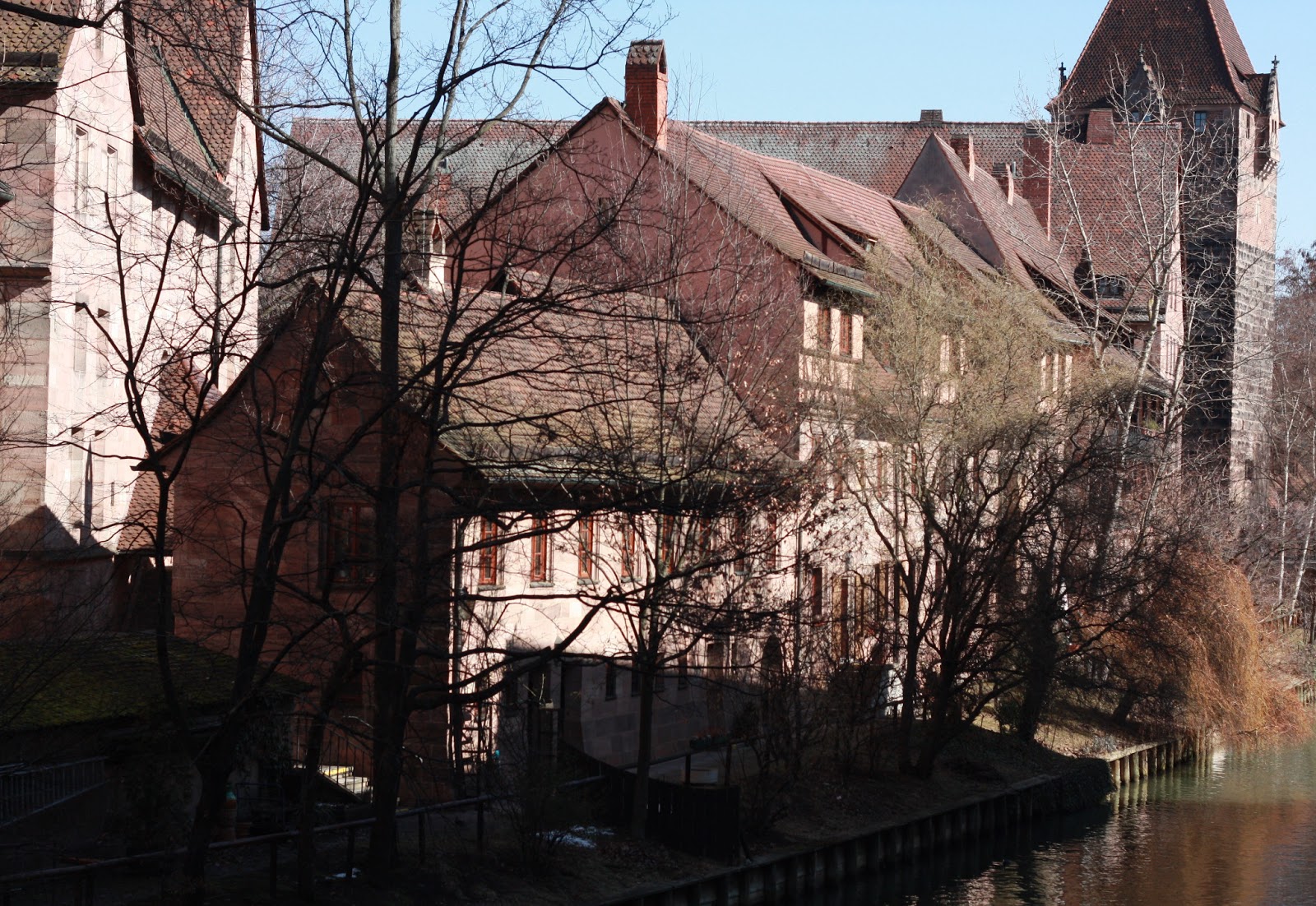
A close friend got a new camera recently.  She suggested a stroll through the city with our cameras.  The day we strolled couldn’t have been a more perfect day.  We are beginning to see 3- 4 hours of sun, shining, and the weather is warming up.  I am happy the weather is turning because there were few days in the middle that I was struggling with staying motivated.  I am grateful for the changing seasons.


Even with bare trees, this was a great trip for photographing. I hope to continue to make these outings.