Copyright

All original content © 2011-2014. Photos and Text, unless otherwise stated, are by the author of Pork Bier Belly. If you want to use images or writing, please ask for permission prior to using.
Showing posts with label restaurant. Show all posts

Tuesday, February 25

Southern Spain- Seville & Malaga

Seville is the largest city in the state and receives the most visitors due to its size, Flamenco and Alcazar. In the walking tour, we learned of the Giralda (attached to the Cathedral) that was built as a Minaret but eventually converted to bell tower. We learned thoroughly of the conquest of the city by Ferdinand III in 13th century. After touring through the city on foot, one of my favorite spots was Plaza de Espana, a large square with renaissance architecture now houses government offices and decorative tiles.


After the tour we headed to Bar Alfalfa in the city. With a full bar and standing room only we ordered few tapas at the bar. When we entered, few tables had a cheesy dip so we ordered that, Pollo al Horno, Sliced bread with melted cheese and Jamon, Paella, Salmorejo and Blood Sangria to wash it all down with. The “blood” was play on words due to Halloween. Our favorite was the baked cheese made with Provolone and dipped with bread. Paella was cooked with seafood and although very good on flavors it was under salted. Both the Salmorejo and the bread with jamon were acceptable while the jamon provided great flavors, deeming it memorable. Our least favorite was the Pollo al Horno which was boiled chicken, seasoned with salt so overall bland. The sangria was excellent with a hint of cinnamon.


That afternoon we visited the Alcazar, located minutes from the Cathedral. It was built during Moorish era as a fort and is now restored as a palace. Due to the high number of visitors to the Alhambra, the Alcazar is the opposite and relaxed. The palace was first built as a main fort and then had additions added later by kings and queens. There are more gardens than you’d expect and some are worth the stroll. There is a lot of history to the Alcazar including the transformation from Muslim era to Christian. When we were there they didn’t offer guided tours so we opted for the audio guide and we recommend it. And unlike the Alhambra, stroll at your own pace without feeling rushed. I mentioned the husband was underwhelmed by the architecture (because of seeing it in Turkey & India) but if he had to pick one over another, he recommends the Alhambra over the Alcazar. In my opinion, if you have the time, visit both.

Bar Modesto serves food and also has a restaurant across the street (I am not sure if they are related). We ordered Gambas in Ajio (shrimp in garlic sauce), mushrooms with shrimp and Jamon, Potato salad with seafood, and Albondigas (meatballs). The shrimp were served hot in a Cazuela, very garlicky and a hint of red chili flakes. The meatballs were made of deer meat, served with tomato sauce and unusually memorable. And the other dishes were very good also. An important note about the service, it is extremely wonderful. Our server was a short, petite man and very understanding. He suggested couple of our dishes for the night and we were happy he chose them.

We dedicated the next day to wondering Seville on our own and hoping to find some gems, starting with a visit to Triana Market (the largest farmers market in the city) at 10am. Upon entering, most of the stalls were still shut and boarded up. We found ourselves across the street at an unnamed café for breakfast. We ordered pan con tomate y jamon (bread with tomato and ham) with cortado, shot of espresso with warm milk. (Apparently cortados are all the rage in US- mainly NYC because things have to be cool and mainstream to get attention.) At this café it was strong but delightful. After breakfast, we saw many homes and streets dotted with citrus trees and beautiful tiles. It is obvious the Moors impacted this area tremendously with their colorful creativity.

Bodeguita Romero was a quick snack before an actual lunch. The reason to visit this place was to try Pringa, sandwich made normally with beef or pork. We ordered braised pork cheek Pringa and the server suggested Pavia de Baccalao. Pavia is salted cod that’s breaded and deep fried. Both were very good, the pringa was rich from the fatty cheeks but tasty with a glass of beer. Romero is best for a quick lunch or post dinner snacks.

Then it was off to Enrique Becerra around the corner. 1 because it was so close and 2 because why not? That day was dedicated to good food. This place was packed with locals and was standing room only. The back used for dinner is curtained off during lunch. If you can snatch a bar stool seat or two, you’re lucky, which we were. Seeing others’ tables, we pointed and got some of the same things as the locals, chocos en la Rioja, Salmon in White Sauce and Albondigas. The chocos (squid) was braised for hours in Rioja red wine sauce and one of the husband’s favorite things in that meal, to our surprise. The Albondigas were my favorite from the entire trip because they are made with lamb and flavors of mint. The fish in white sauce was served in bite sized pieces per person. It was also good but we couldn’t understand why others around us kept ordering it. Later we learned the fish was their daily special and was half off hence the multiple orders from the same people.

That afternoon we spent relaxing in our room. Before dinner we walked over to Triana market at 5pm for a stroll and found all the stalls were boarding up. Do these people actually open for more than 2 hours?

It was off to Bar Modesto again before a Flamenco show. We ordered new dishes, fish and seafood soup, sea bass with cauliflower and pearl wheat, grilled squid with cauliflower, fresh shrimp and stuffed zucchini with seafood. The sea bass was a winner with balancing flavors and textures from the veg and bulgur. The shrimp were cold and with head on but very fresh. And the soup was nice, the stock made with fish bones. While the stuffed zucchini was good, the concept was too modern, especially for a restaurant like Modesto.


If you are interested in seeing Flamenco, make sure to book seats before the show and arrive early. At Casa De La Memoria, you stand in line, first come first serve basis and therefore score good seats. We had never seen Flamenco, even on TV, so it was a new for us. We learned, later, Flamenco was started by the Romani people in Andalucía and is a combination of singing, dancing and playing the guitar. We both recommend Casa de La Memoria because it devotes the evening to the singing, dancing and its dancers and the expression of tragedy and happiness; there isn’t food and there isn’t conversation. The show here was unexpectedly good and the dancing was brilliant.

Breakfast in southern Spain is impossible to find. We conclude it is because people party late into the night and don’t wake up in time for breakfast. If the hotel provides breakfast, opt for that.

We’ve done walking tours in other cities we’ve visited. The premise is a local person offers a tour in English with highlights of the city in 2-3 hours. Our experience in Seville with knowledgeable Santiago from Columbia was descriptive and he recommended a tour in Malaga so we drove to Malaga the next morning for the tour and lunch.  In the tour, we enjoyed Malaga on a beautiful day and saw sights.  Unfortunately the tour guide wasn’t very good and mostly complained about the Spanish economy driving out the locals to other parts of Europe or America. At one point, the husband and I rolled our eyes and said “we get it dude, you’re angry about the country’s economy.” Who wants a sulky tour guide? Though seeing Roman ruins in Malaga was a neat experience.

After the tour, we walked into La Campana. This place is busy with locals so expect to stand outside or tightly squeeze into the restaurant and stand by the bar. Busy might be an understatement, sardines in a can is a better description. You have to push your way through and order at the bar. Getting the servers’ attention is impossible with others trying to do the same.

We ordered Boquerones (deep fried Anchovies), Calamari, Puplo (fried Octopus), Torta de Camarones (Shrimp pancakes) and Mussels. Everything we ordered was fried. I believe, almost everything on the menu is fried. So as they say, if it’s fried or swimming in butter, it is bound to be delicious; we agree. Everything we got was perfect, the calamari and octopus were a little overdone but nothing to complain about. Others were ordering Gambas a la Mancha, cooked shrimp, served cold. We wished we had ordered that but we were stuffed. The local bier of choice is Victoria (especially at this restaurant) so we followed suit and ordered it and a St. Miguel. The environment at La Campana is blue collar so expectation of high class and status need to be left at the door.

Once our trip and driving around Andalucía was over, we drove to Malaga on our last night for dinner and sleep before our early morning (6am!) flight back home. We stayed at the Amador, highly rated restaurant and hotel. The room on the top floor has stunning view of the sea. We enjoyed the view for 2- 3 hours during dinner at the restaurant. We ordered ajo blanco, garlic and almond soup with shrimp and grape sorbet. Grape sorbet with garlic soup? It’s that type of restaurant. It was a fantastic combination. We ordered paella with shrimps, cuttlefish and monkfish for two. (Southern Spain isn’t known for paella but we wanted something other than tapas and all the meat dishes seemed too heavy.) The seafood was fresh and perfectly cooked, the rice was fine but we had paella in another trip (report coming soon) and that one was more memorable and worth every bite.

From the multiple trips we have taken thus far Spain has captured my heart. Now about that dream....

Sunday, February 16

Southern Spain- Cordoba & Granada

We’ve been to Spain twice already and it’s peak time I share those experiences. First, of the most recent experience. (Although Mallorca is part of Spain, I view that trip differently; it was a ladies trip.)

When I had not been to Spain, ever (a Spain-virgin you can say), my dream was to move there, buy a bed and breakfast and live amongst the orange groves. After our first trip on a momentous birthday, I knew we would return. The second third time we went to Southern parts in October. I had read Autumn is a good time to go, as well as Spring, to avoid the crowds and the outrageous temperatures.

For this trip we planned to arrive in Malaga and drive to few of the cities nearby and return from Malaga. We drove couple hours and started our trip at Hotel Macia Alfaros Cordoba. It was cramped but our room was sufficient. Our room faced another white building so the view was disappointing but it was to be expected of a hotel in the heart of a city. It has a large breakfast room in the basement and a spacious lobby but otherwise small hallways and small quarters.

On the first night we ate dinner at the highly sought after Bodegas Mezquita. It was busy, as expected; there were locals as well as many tourists with their displayed guidebooks on the dining table. We ordered the pre-fixed tapas menu with 6 tapas chosen by the chef. Salmorejo, garlic and tomato soup, served cold was delicious and memorable. The bean soup with chorizo and Morcilla (blood sausage and both are Spanish) was good however over salted while the garlic covered potatoes were under salted. Eggplant fries were unique because they were light and crispy but unfortunately also under seasoned. The husband’s favorite dish from that night was Ratatouille, stewed vegetables from the late summer harvest and perfectly seasoned and hearty. I was surprised Cordoba serves Ratatouille, isn't it French? Overall the cost and the food were passable with some hits and few misses; if in Cordoba I suggest an authentic place for local food.

Cordoba is unique for one reason, the Cathedral. This Cathedral has enough history to spend a whole day and it is wonderful. It has Muslim influences from when the Moors were in Spain as well as Catholic touches. It was first a Mosque that was converted to Catholic church, back to Mosque and again to church. When the construction first started it was built to face Mecca for prayer. In the last Moorish acquisition it was expanded to hold 40,000 people. If you get to go, an audio guide or a tour guide is a must. The audio guide that comes with the tickets is sufficient.

After touring the Cathedral, we walked over to Casa Rubio for lunch. The server is Spanish (possibly?) and was born in Germany when his parents moved there before his birth. He moved to Spain 15- 20 years ago. He was helpful and it was nice he spoke German. He suggested Boquerones (fried anchovies) as one of our Tapas so we got it. He also recommended another seafood dish that we declined and instead we ordered Potatoes with spicy sauce (against our server’s warning) and Salmorejo. Rookie mistake. The Salmorejo was very good however the potatoes were terrible, as he had implied. But the most memorable plate was the fried anchovies and I am glad we went with his suggestion.

By the way, a trap at Casa Rubio (and many restaurants with outdoor seating, probably) if seated outside, there’s an extra service charge than to sit inside. We chose a table inside and interestingly enough the interior is charming and decorated with crafts from the region.

Jewish quarter in Cordoba is admired by the tourists and it is neat to walk around; 2 hours in the district is plenty of time. In addition to the cathedral and the Jewish quarter, we walked over the Roman Bridge, built in the 1st century.
Taberna Salinas is tucked away in a neighborhood that many tourists don’t venture to. The advantage for us was its close proximity to our hotel so we went for the last dinner in Cordoba. It is highly praised and understandably so, the restaurant was packed with locals and some tourists on a weeknight. Thankfully we were able to get a table without a reservation. One dish that’s recommended is Rabo de Toro (oxtail stew). We shared the stew, Salmorejo (do you sense a pattern?) and espinicas con garbanzos (spinach with chickpeas). The meat in the stew was falling off the bone and very flavorful. The spinach and chickpeas were also tasty; the ratio was more spinach and less chickpeas, unlike how I’ve made it in the past. Salmorejo was fine. The server suggested the day’s dessert and the husband ordered it for me because I have a sweet tooth. Sadly the dessert was average. The server was pleasant and attentive and Taberna Salinas served the best food in Cordoba.

We went for the hot bath before dinner one evening. According to history, these baths were a meeting place for the people (mostly Muslims) when they lived here, and a way to meet, chat, enjoy one another’s companies while also bathing. We were hoping to experience it like in Istanbul. This bath was different. It has 4 rooms; steam room, cold water room, hot water room and a room with swimming pool. The idea is to rotate amongst those 4 rooms for couple hours. The cold room is freezing and the hot water is scorching but that’s the point. And there are masseuses that give guests massages (must be scheduled ahead). Obviously to prevent people from staying there all day, groups are allowed in on set time bases and have to leave at a certain time. Our massages were schedule in the last time slot. Not only was our massage rushed but this experience compared to Istanbul was below average. It was filled with tourists and it didn’t have an hot bath (like they used to do it) charm. The same Hot Bath company owns locations in Granada and Seville; we say don’t bother wasting your money.

If you’re in the area, Cordoba deserves a stop for 1- 2 days. It is easy to see the entire city in a day but it would be a rushed day-trip.

In Granada our Bed & Breakfast, Los Rebites, was comfortable and spacious but away from downtown. Our room had a large bathroom as well as a balcony, overlooking the city of Granada. Although the B&B was satisfactory, the daily commute into the city was not.
Since we arrived late to Granada, we went to the local supermarket to stock up on olive oil, canned fish and cured meats. Iberico Jamon (ham) was pricy so we opted for Chorizo instead. After shopping we were completely lost in the city and couldn’t find a restaurant on my list so ended up back at the Bed & Breakfast.

We were back in the suburbs and it was late so our host recommended a restaurant on the next block. When we entered the restaurant was empty, a discouraging sign. However after a long day we chose to sit. The young server didn’t speak much English so we tried our best to get some recommendations. He suggested the daily special, lamb chops and we agreed to share a plate. For appetizer we ordered spinach croquettas which were binded with mashed potatoes, breaded and fried. In the croquettes the spinach had a hint of nutmeg, a memorable touch. For the first course we got potato ensalada (salad- typical to Andalucía), on the house; it was exceptional with garlicky and olive oil notes. Instead of lamb chops we got pork with french fries. We asked about the lamb and the server couldn’t explain the problem. Lost in translation. The pork was perfectly cooked and garlicky unfortunately it was swimming in olive oil and greasy. And the French fries were overkill with potato salad on the house as well as croquettas with potato binder; another vegetable would’ve been appreciated.

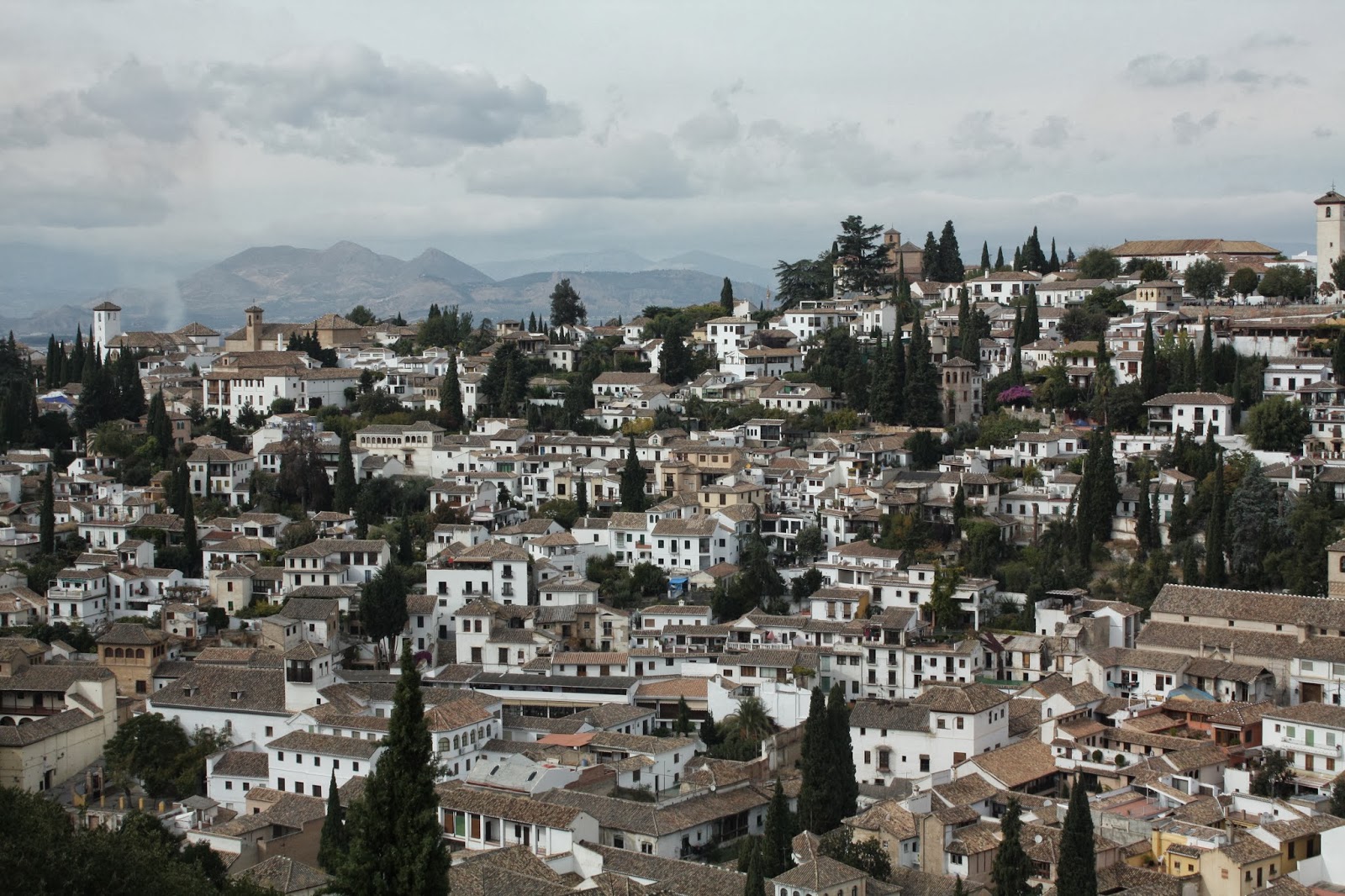
Granada is systematic and has a comprehensive public transportation system. From our bed and breakfast we took the bus into the city each day. The first full day we visited the neighborhood of Albayzín. It is an UNESCO site because it’s one of the oldest neighborhoods on a hill overlooking the valley and filled with white homes and has panoramic views of the Alhambra. The architecture reflects the Moorish culture with brightly colored tiles and balconies. When the Muslims were pushed out of other Andalucían cities, they settled in Granada (particularly Albayzín), the only city that wasn’t conquered, yet.

We went to La Ladrillo for lunch. This place had locals sitting on the patio. And they offered menu of the day, a welcome change from the tapas. For the first course, we each ordered Migas, fried bread crumbs with whole roasted garlic cloves topped with fried sardine. The flavors were distinct because of the fresh sardine and roasted garlic but the bread crumbs were not crispy. For main I ordered cerdo (pork pieces) and the husband ordered pork back. Both were garlicky and delectable. I love the Spaniards love of garlic. The husband’s pork was slightly overcooked in some parts, easy to do when it’s thin filets. For sides, we got fries, again. I don’t love the Spaniards’ love of French fries. For dessert I ordered flan and he got coffee. The flan was ordinary.

After visiting the Cathedral and walking around other parts of the city, we went back to our room to relax. Later we headed back to Albayzín to watch the sunset and see the Alhambra at dusk before walking to dinner. We were determined to find a Moroccan or North African restaurant due to the strong Muslim influence; we found Restaurante Arrayanes for dinner. I ordered a Chicken Tagine with preserved lemons and olives while the husband ordered lamb with vegetables. Both dishes were great, a tad under seasoned but still terrific.

On our way to the Alhambra the next morning, the husband wanted to get shwarma from Shwarma King before heading to the palace. It was below average and we both agreed expectations have to be low when buying food from a restaurant on the main road to a tourist sight/ the Alhambra.

Alhambra is a combined palace and fortress on a hill, with initial construction in 9th century. It was neglected until the Moors and the King revamped the palace in the 11th century. The visit to Alhambra requires advanced planning; visitors must book tickets online and are given a specific time for entrance. Due to high volume of visitors per day, the center is strict about entering on the scheduled time. Each time slot allows 4 hours per visit and many areas have an automated machine that scans ticket. Audio guides can be rented and we both recommend them. Following the ticket instructions, begin at the Nasrid Palace. There is a lot to see and learn in the palace and due to its magnificent size it’s easy to get lost in.

I will honestly say that Alhambra is worth a visit while the husband was shocked at the rave reviews from visitors. For someone that has seen Arabic influenced architecture in India & Turkey, to be precise, he was underwhelmed. For me, if there was an 8th wonder of the world, the Alhambra deserves that spot. It is impressive inside and out.


In one of the guidebooks, I had read about convents in Granada selling cookies. Of course I had to find one myself. While in Albayzín, we located one but unfortunately they were closed. The next day, before the Alhambra, we found Monasterio de Santa Catalina de Zafra with the help of a tourist office suggestion. They are conveniently located on the path to the Alhambra. Inside the instructions state to ring the bell and order from a list of 3-4 cookies. After waiting 3-4 minutes, a nun answered. Here’s the neat part. The nuns are behind a rotating carousel window (lazy susan with covered window) and customers can’t see them. She asked me what I wanted so I asked for Polvorones and Mantecados. She put 500 grams each and turned the wheel. After seeing them, I requested in my broken Spanish 250 grams of each. She took them back, repacked them in smaller bags and charged me 6 Euros. I put my money in the carousel and walked away with homemade Polvorones and Mantecados from the convent.

Polvorones and Mantecados are shortbread cookies made with fat, powdered sugar and sometimes contain almonds. Mantecados are made with lard. They are crumbly because it’s mostly butter or lard and nuts, great with coffee or tea. Word of warning, don’t buy these BEFORE the Alhambra tour because food can’t be left in lockers and you have to walk around for 4 hours with the cookies; it will yield crumbly cookies when you’re home. None the less I loved the idea of nuns selling their homemade food. And the cookies were rich and delightful.

Wednesday, January 22

Regional Food

As you’ve noticed around here, there aren’t many any posts about German food. That’s because there are very few things that we love eating out at German restaurants. There’s the drei im weggla (three Nürnbergers in a bun/roll), schnitzel and finally Schäufele.

Nürnbergers are sausages named after the city because they were invented here; in the land of bier, sausages are appropriate. Schnitzel in Austria is veal filet breaded and fried while here in Bavaria it is pork filet also breaded and fried. Schäufele is pork shoulder braised for hours and then the skin is scored and crisped under the broiler. Normally Schäufele is served with Knödel, a dumpling made from potatoes and a little flour. Generally they are very starchy (gummy) because waxy potatoes are used.

Thankfully when we had it this past weekend, not only was the Schäufele cooked perfectly, moist and tender but the Knödel was also very good (not gummy). We rented a car this weekend and drove to a small town 45 minutes from here for a lunch of Schäufele and Knödel at Gasthaus Schiller in Wernsdorf.

Normally Schäufele is served with sauerkraut (one of the foods Germans are known for). However at Gasthaus Schiller we did not get Schäufele with sauerkraut; it might be regional.

While we are on the topic let’s talk about regional differences. Even within the state of Bavaria and the Franken (see map here) area, there are specialties that don’t cross certain lines. The said lines are tricky to decipher.

Language follows suit the same way. Servus for instance is a form of greeting (hello and goodbye) in Munich and its surrounding towns while servus (I personally learned from my farm stand lady) is only used to say goodbye in the Nürnberg region. Say what?

Moral of this story? Germans, Bavarians are protective of their culture, language and especially food so you may not have the same dish in two restaurants some kilometers from each other.

Saturday, January 18

Essigbrätlein

The husband and I celebrated our marriage anniversary at a local Michelin star restaurant. It was planned months in advance because for a table at Essigbrätlein you have to book ahead.

We opted for the 6 course pre-fixe meal. The meals change frequently so this is a brief synopsis of our dinner.
To start we had multiple amuse-bouches, one of which was a Brussels sprout leaf wrapped in a creamy filling and another was sunflower seeds with sunflower oil. The sunflower seeds on a spoon were crunchy and salty in one bite. The brussels sprouts were a stand out because the mascarpone like filling was the perfect balance to the fresh leaf.

First course was Trout with Fennel, a largely cubed trout sitting atop sliced fennel and dressed with vinaigrette. Next course was layered mashed potatoes with sauerkraut with soy sauce on the side. The soy sauce reduction seemed odd at first but once we tasted it all together, it worked. One of the most impressive courses of the evening, for me, was the pigeon over black salsify with a hint of horseradish all topped with fried shallots (imagine fried onions on the green bean casserole, but much lighter). The pigeon was pan fried and cooked rare. For never having tasted pigeon, this was the perfect introduction.

Finally dessert course was a chocolate mousse ice cream with crunchy chocolate nibs and chocolate comb. Chocolate comb meaning it looked like a honey comb but solely made out of chocolate. It melted in our mouths as soon as we ate it. I wonder how the comb is made because it was one of the most memorable chocolates I’ve had. Of course, rest of the dessert plate was delicious too.

After reviewing the wine menu, not a lot was tempting and the ones we liked were beyond our price range. Based on our preferences, the server brought an Austrian Blaufränkisch bottle; it paired with the meal flawlessly because it was light, like most of our courses, and fruity.

Dinner here is an indulgence (on the palette and your wallet), but it's worth the price and I highly recommend Essigbrätlein for a meal.

Saturday, December 7

Tuscany- Part II

About that trip I was telling you about.

The next morning we drove to Gaiole for few more tastings. The first stop was Barone Ricasoli. The history at Ricasoli is interesting, being the oldest winery in Tuscany and Barone Ricasoli was the first to write the Chianti recipe and marketing to importers in the 1800s thus putting the region on the wine map. Additionally, parts of the castle are preserved with artifacts from Barone Ricasoli’s era. The brief castle tour is worthy.

The Enoteca at the bottom of the hill hosts tastings. It is a fancier environment with modern décor. Post tasting, we went to the town of Gaiole for lunch and little sightseeing. Unfortunately, there was a bike expo that day so the town was filled with bike stalls and full of bicyclists. We found a lunch spot on the fly at i galletto briaco Ristorante Pizzeria. As soon as we sat down, the host announced,” no pizza!” Instead we ordered Ribollita (typical Tuscan soup with kale and white beans), penne with tomato sauce, ravioli with sage and butter sauce and mozzarella sticks. The sticks were a disappointment, not surprisingly; the nonna in the kitchen probably rarely fries up breaded mozzarella unlike chain restaurants in America. My ribollita was perfect and exactly what I was craving. I tasted a lot of onion and carrots as the base for flavoring. The husband’s ravioli was rich and creamy and our friend said the tomato sauce with penne had good flavor.

Castello D'Albola was the next planned winery. They offer tours and tastings for free and both were worth the visit. This was the first tour I learned about the grapes grown on site, and wine production.

And to finish off, we went to Poggio Alloro for tour, tasting and dinner. This place has been around since the 1970s and started by 3 brothers who wanted to produce wine and a farm to grow olives, saffron and vegetables. As of recent, the farm raises cows for meat. We learned of the struggles the brothers faced to start this vineyard. Notably, we saw one of the brothers working at his age on the farm. Followed by the tour, we sat outside and watched the sunset and the city of San Gimignano in distance with our wine tastings, olives, bread and cured meats.


Dinner started promptly at 8 and again it was communal. This time, the room was much larger, the guest list longer, the options diverse and proportions large. There were many things we ate that night; to name the outstanding ones were an appetizer with baked polenta topped with ragu and a frittata. The risotto was a little under done but cooking for a large group, daily can have possible mishaps. The main course was turkey with veggies and though it was good, I was sad we weren’t eating the steak from the cows. We finished with a Panna cotta. There were unlimited breads, cured meats, olives, water and house wine. You can’t go wrong with a place that lets you eat like a king.
Walking away from dinner, one distinctive quality of Poggio Alloro is their customer service. Everyone was extremely friendly, willing to answer any of our questions and very accommodating. I highly, highly recommend Poggio Alloro for a tour, tasting and dinner. If not all, at least the dinner. Reserve for Saturday’s communal dinner to have the steak.

The next day was rainy and cold so we toured San Gimignano. With interesting history, this town is medieval, walled-in, and has 14 towers still standing that encompass the old town. This should be on everyone’s list to visit because of its small town charm. We ate Gelato in a shop that has won “best gelato award” for few years. The artisan that makes the gelato is well recognized in Italy and sought after.

As a total surprise, my husband and the other husband planned a cooking class for us. I had no idea what was going on when the two women showed up and said “We’re here for the cooking class.” It was a delightful surprise. With the help of the cooks, we cooked Bruschetta with Raddichio and Cheese, Squash Blossom Zeppole (Italian fritters), stuffed Veal (stuffed with prosciutto, sautéed zucchini, and omelet), Pici (local pasta) with tomato sauce and basil, and Flortentine cake. Phew. We were thrilled to learn to make simple (eggless) pasta and stuffed Veal. Overall this was a magnificent experience.

Tuscany is exactly as I had imagined but so much more when experiencing it in person. Everywhere we looked there are rolling hills covered in vine groves and dotted with cypress trees. It is scenic. Chianti wine is fruity and pleasant with a meal or on its own. We learned of a new white grape grown only in the region of San Gimignano, Veranacci, it subtly tastes like Sauvignon Blanc which we are not fans of. The local cheese is Pecorino and if the local producer is selling it, stock up. We bought 1.5 kilos (we drove to Tuscany to bring back wine and cheese) from a cheese shop that produces pecorino, ricotta and few other cheeses.

October is one of the better times to visit; it’s the beginning of harvest season so the vines were full of grapes, ready to be picked. Unfortunately that also means many wineries do not offer tours or tastings however we found enough that offered tours and/or tastings. And this trip was extra fun because of our friends. Eating typical Tuscan food, drinking wine and sharing laughs will make this as an unforgettable trip.

Sunday, December 1

Tuscany- Part I

After Dublin Ireland, this was our 2nd trip, traveling with friends. Although we’ve traveled with family this year, we wanted to make this trip with some friends. When they suggested a trip to the Tuscany region of Italy for wine and food, we agreed, of course.

There was weeks of planning that went into this trip. We were going with someone that’s a planner, like myself. We had 2 days of wine tastings planned, 1 daytrip to a city and another day to relax and take-in Tuscany.

After arriving on Wednesday evening, we had 20 minutes to unload our car and drive to dinner. We asked our Villa host directions to the restaurant and she said, in broken English, at the end of the road, turn left. Of course our GPS gave us an alternate route. Relying too much on technology, we followed the GPS and were completely lost. Thankfully with a phone call to the restaurant and directions, we got there 10 minutes after 8pm.

We ate at Agriturismo Il Vecchio Maneggi, communal style with 10 other guests. The host is a nonna that loves to feed her guests until we can’t eat anymore. We had multiple courses of cured meats, Farro soup, gnocchi, pork with saffron laced potatoes and salad, local (pecorino) cheeses and dessert. Our favorite were the farro soup, mashed potatoes with saffron and the cheeses with honey. There was always a full bottle of house wine on the table so unlimited wine was a bonus. The price is reasonable and the meal is worth the trek out to this agriturismo. During dinner, we learned they have few rooms for guests to stay and offer cooking classes. And if all that weren’t enough, they sell housemade wine, honey and oil on site.

The next day we left early and headed to Greve for wine tastings. First was Castello di Verrazzano for a beautiful view of the heart of Tuscany. The tour was engaging, especially the cellar with their iced grapes for dessert wine and displaying barrels of chianti.

Next was Castello Vicchiomaggio, down the street and across the hilltop from the first. We had the opportunity to try their wine at the shop and then walk around the winery’s garden, church and premises. For good views, both of these wineries in Greve are the place to visit on a beautiful, sunny day. For lunch in Greve, we stopped in at Enoteca Fuoripiazza in the smaller square. I recommend this for a quick lunch amidst wine tastings. It doesn’t offer gastronomic treasure of Tuscan specialties however the pasta and the meat dishes were fair. The restaurant host suggested we walk to the main square in Greve. The square is small and charming with a bread shop, butcher shop and a city building.

While driving to the next winery the husband pulled into an unassuming winery with a “We sell wine” sign. We rang the cowbell hanging on the door and within minutes pulled up a woman in her car. We tried their house wine as well as olive oils to buy. The husband and I were impressed with both. It was one of the most inexpensive wines we’d bought on the entire trip, costing 6-7 Euros/bottle.

Another winery we visited was Fattoria le Fonti which is impossible to find in the hilly town of Panzano. Although there are signs, we were going in circles trying to find the place. At last, we did find it and had a brief tasting. The woman that was doing the tasting was from Germany and interning for a short time. It was fun to speak German with her. She explained the owner is German who quit his job and bought the winery and works there full time. What a dream come true.

Dinner was at Taverna Bibbiano. That particular evening was Latin night with karaoke music and buffet. We opted out of that option and ordered a la carte from the menu. Instead of ordering by courses, we ordered an appetizer, a meat dish, and pasta, all to share. Our friends ordered three pastas to share. Our wild boar (chiangale) ragu with polenta was good however the polenta was cold, disappointing. And our friends said their risotto wasn’t very good. Other dishes were fine; the dinner was average. Although the meal wasn’t memorable, the evening was. When we were almost finished with our meal, we saw people run after something with big sticks. With the help of another restaurant guest, we learned there was a thief and they were chasing him off property. I can’t remember the last time I’ve seen or heard of someone running after a thief with a wooden stick.

Friday, November 16

New Restaurants to Share

As you may have noticed, I haven’t written many restaurant reviews here. One reason for that is it’s truly difficult to find memorable restaurants here. We try various places but without success. Sadly, I’ve found myself saying I rather eat in or make something from scratch instead of testing a new restaurant only to be disappointed. But here’s a list of few that are worth mentioning.

Per Bacco is an Italian place we most recently tried with some friends. It’s in a residential corner of Gostenhof. The restaurant has a deli on the right side and formal seating on the left. The seating area for customers is small but intimate. There is a large map of Italy on the wall with wines listed shown from the country’s regions. There is also a large blackboard that lists the daily pasta specials. In the 15+ pasta dishes to choose from, they had 4 homemade pastas. The ones I remember were Ravioli, Pappardelle, and Fazzoletti.

That night, the husband ordered spaghetti with scampi (langostines) while I opted for the Fazzoletti. (I always get homemade pasta because it features the chef and the restaurant’s pasta making skills). One woman in our group got the ravioli, her husband the calamari. The 2nd couple ordered Fazzoletti and pasta with horse meat sauce. Generally speaking, I think calamari is really hard to make or easy to overcook or undercook but the person that got it said it was perfectly cooked. The ravioli was filled with spinach and cheese and appreciated for its delicate taste. The pasta with the horse meat was unexpectedly delicious. We were all a tad nervous to try horse meat but it was one of my favorite new tastes. The husband’s langostines looked tasty (he said they were fine) and the pasta and sauce were good. Fazzoletti are little handkerchiefs and filled. Mine were filled with chestnuts and then sauteed in a sausage, olive oil sauce. At first it sounded unusual but upon first bite, I was intrigued. I wouldn’t normally pair chestnuts with sausage sauce but this was delectable. Unfortunately for me, I am not a fan of sweet filling for pasta as a main course so I was put off by the chestnuts but I highly recommend trying it if it’s on the menu. We shared a Tiramisu and that was rich. Overall Per Bacco gets high praise for the service, wine and food; it’s hidden for good reason.

Another place that I am raving to everyone about is a sushi restaurant. Sushi is my all-time favorite food and it’s close to impossible to find a place that offers fresh fish and seafood with impressive rolls. I’d heard good things about Sushi Edo from various people but hadn’t made it to the place until recently. A friend and I met up for a sushi lunch and were surprised by its location. Not only is Sushi Edo few stops from Altstadt (downtown), it’s hidden behind business/office buildings. The restaurant is a large space with modern Japanese décor. I got the Spicy Tuna and Salmon Skin roll and their version of Spider Roll. The fish was very fresh and there was an actual fiery kick to the spicy Tuna roll. My friend liked all her rolls. She is also a sushi fan and agreed this was one of the best restaurants she’d tried here.

The first time the husband and I tried Ethiopian food was in Cincinnati US. Contrary to popular belief, Cincinnati isn’t the hotbed of Ethiopians but the one and only restaurant offers authentic food. It exposed us to a new type of ethnic food. I believe, Ethiopian food is very much like Indian food in that it has lentils of some sort, various vegetarian dishes (cabbage, potatoes, collard greens in its own spices and herbs), and a meat dish that’s all eaten with Injera, a 3rd cousin of the sourdough bread in a spongy, flatbread version. To eat it, you take the Injera bread in one hand and use it to pick up one or mixture of veggies or meat.

We first tried Shashamane months ago but I’ve been behind on reporting on it. Its location is behind the Hauptbahnhof (main railway station), tucked away in an business area. (There's a pattern with all these good places being tucked away.) On the inside the restaurant feels like a Rastafarian home with multiple pictures of Bob Marley and flags of Jamaica. There is also a disco ball. When we went we got a large platter (for two); it came with lamb stew, lentils slowly cooked in spices, cabbage with cumin seeds, sautéed collard greens and lots of Injera bread. Enough bread to fill us up, to the brim. Everything tasted like we had in Cincinnati. Although that doesn’t justify its authenticity, we believe the food we tried in Cincinnati and here at Shashamane was memorable, real and worth repeat visits. The disco ball, we later learned, is for the nights the restaurant turns into a reggae bar.

Finally Herr Lenz is an organic restaurant. It’s one of a kind because they source most of their ingredients locally. They have a weekly menu that changes based on the ingredients sourced for that week. The night we went we ordered a large salad and a braised chicken. My salad came with romaine, red lettuce, cucumbers, tomatoes and onions. The dressing was made of yogurt and mustard. But the one thing that made my salad memorable is the brie wrapped in bacon and briefly toasted. The saltiness of the bacon tied in with the creaminess of the brie was the ultimate addition to the salad. The husband’s braised chicken was browned and then braised in wine sauce with onions, carrots and potatoes. This, by no means is original, but we were both pleasantly surprised with the simple, home cooked taste. Although a salad isn’t a solid enough reason to rave about a restaurant, we are happy to have a restaurant that sources locally on our list.

Wednesday, May 23

Tapas and Spanish Food

We tried a local Tapas restaurant, Santos, near our apartment recently. The atmosphere is cozy and intimate inside. There’s a dining area as well as an area with bar stools and high tops. We were seated at a table for two by the window looking out at the courtyard. Across the courtyard was outdoor seating for Altstadthof Hausbrauerei. We’ve had Altstadthof’s beer and enjoy it thoroughly, especially the Rotebier. Funny enough, we ended up at Altstadthof later in the evening to meet friends for few beers.

I digress. At Santos we ordered drinks, Spanish Chorizo, Patatas Bravas (roasted potatoes) with Romesco sauce, Pollo Rojo (Chicken in Red wine sauce), Calamari (Fried Squid), Bread with Aioli, Sardines in olive oil and garlic. The aioli was a stand out. On our last night in Palma Mallorca, my friend and I went to a fancy restaurant and ordered their homemade aioli, along with other foods. The server brought out freshly baked bread to eat with aioli and we both joked we filled our bellies that night with bread and aioli. It was that good! So I suggested to the husband he try the bread with aioli at Santos. He liked the combination but he wasn't blown away. Too bad. In his defense, in comparison the freshly baked bread with aioli in Palma was better than at Santos. The chicken thighs were tender and falling off the bone and the red wine sauce was notable. Calamari was delicate and fried flawlessly, not overcooked and chewy which is easy to do.  Sardines in olive oil were served cold, acceptable but I was hoping for a warm preparation. Spanish chorizo was thinly sliced and served like cold deli meat; the husband enjoyed it more than I did. Patatas Bravas were our least favorite of all the dishes. They were cooked fine but did not taste extraordinary. The romesco sauce was watery and too acidic from the tomatoes.

Having perused the menu post dinner, there is a larger list of drinks, wine and bier. We guess Santos is a cocktail bar that serves food to accompany. Overall a satisfactory dining experience but not an outstanding one.

Craving Spanish food, I made Chickpea, Meatball Stew from The New Spanish Table. I’ve only made handful of recipes from this cookbook and should cook more from it because everything has turned out really good.

Chickpea Stew with Chorizo and Meatballs
adapted from The New Spanish Table
Serves 4

For the chickpeas
1 cup dried chickpeas, soaked overnight
1 bay leaf

For the meatballs
10 ounces ground pork
1/4 cup grated onion
1 egg, lightly beaten
1/2 teaspoon smoked sweet Spanish paprika
Pinch of salt and freshly ground black pepper
extra-virgin olive oil

For finishing the stew
2 tablespoons extra-virgin olive oil
1 medium onion, finely chopped
1 carrot, finely chopped
4 garlic cloves, minced
1 large ripe tomato, chopped
1 teaspoon smoked sweet Spanish paprika
6 ounces Spanish Chorizo, sliced
1/4 teaspoon salt and freshly ground black pepper

Soak chickpeas overnight in cold water. Drain in colander and place drained chickpeas in a large saucepan with 2 inches of water to cover on high heat and bring to boil. Once the water is boiling, add bay leaf and reduce heat to low and simmer, partially covered for 1 ½ hours. If foam rises to the top, skim off the foam with a slotted spoon. If the water level gets really low, add water to the pot. 

While the chickpeas are cooking, form the meatballs. Combine pork with grated onion, egg, paprika, salt and pepper. If the meatball mixture is too moist to form meatballs, place in the fridge for 30 minutes.  With oiled hands, shape the mixture into golf ball sized meatballs.  Heat olive oil in a large pan on medium heat and cook the meatballs until they are browned on both sides. Cook the meatballs in batches, if necessary.

In the same pan with the meatball drippings, add the onion, carrots, and garlic over a medium heat until they soft but not browned, around 5 minutes. Add the chopped tomatoes, paprika and chorizo, then cover the pan and cook for another 5 minutes. Season with salt and freshly ground pepper.

Taste the chickpeas for doneness. If chickpeas are done, remove from water with a slotted spoon and add the chickpeas to the onion-tomato-chorizo mixture. If chickpeas are not done, continue cooking until done. In the meantime, turn off the heat for onion-tomato-chorizo mixture. Once chickpeas are added, add salt and freshly ground pepper and simmer on medium-low for 20 minutes. Add the meatballs at the end and simmer for another 10 minutes. Taste the stew and season with salt and pepper as needed. 

Serve hot or warm.

Saturday, June 4

Food Reviews

There are few places that we've had meals at that's worth writing about.

Hotel Maxmilian This is our breakfast/brunch place in our hotel.  Although the service is wonderful, the food is dull.  German food mostly consists of bread (brot), sausages (wurst), and saurkraut, it's isn't a cuisine that people rave about however there's potential to make it taste good, especially for breakfast/brunch.  Our daily selection includes some type of sausage, deli meats of sorts (pastrami, salami, bologna), smoked salmon, scrambled eggs, variety of breads, cheese, jelly and a sweet cake/dessert (Kuchen) on most days.  On alternate days, they switch out the sausage with chicken wings and bagel bites (American version) or  mini pizzas.  That's where I have a problem with this place, I am okay with sausages but when they're switched out for a lesser tasting bagel bites pizza, that's not good.  Starting tomorrow, we plan to venture out to a new breakfast place down the street.

Sangam is an Indian restaurant we went to with an expat group.  The group meets at a different restaurant each week, it's my kind of group.  The restaurant itself is in a prime spot in old town, blocks from the u-bahn station.  We were part of a group of 8 so nothing unusual for a restaurant you would think, but the service was terribly slow.  The server that took our drink order, 30 minutes after we were seated (no exaggeration), said he couldn't take our dinner order.  Another 30 minutes later, the owner took our dinner order.  At 9:30, 2 hours after arriving at the restaurant we got our food.  He and I shared an appetizer, Chicken Tandoori, and the main course, Bhuna Ghost with Roti.  The chicken was well seasoned and tender, the bhuna ghost was rich in a creamy tomato sauce.  Others in the group got butter chicken and daal which they all liked.  However they said this was their 2nd or 3rd visit and each time got the same slow service.  Overall the food was good but definitely not worth going back due to their repetitive slow service.

Now onto the food places we've liked.  The first was a German restaurant in old town, Hütt'n.  I ordered Nuremberg wurst special with bread dumplings and he ordered pork loin roast with potato dumplings.  My wursts came in a thick brown sauce that was rich, flavorful and lemony at the same time.  And it paired fantastically with the bread dumplings, a Franconian local specialty.  His pork loin was braised to perfection with crunchy skin, like pork rinds.  The crunchy pork skin isn't for everyone but I tried it for the first time and loved it.  His potato dumplings were a tad bland but we can't expect too much from boiled potatoes formed into a ball.

The other German place that we enjoyed was Kartofell, literally translates to potato.  This restaurant is a block from where we're staying so it's a nice 2 minute walk.  It was recommended by someone so we were excited to try it.  It has an outdoor patio that everyone was drinking bier and having their dinner in so it was only fitting we sat there.  Everything on the menu has some sort of potato- fried, boiled, steamed, baked or shredded & fried.  I ordered the schweine schnitzel with boiled potato and white asparagus.  He ordered the chicken burger with green salad.  When we got our plates, we were both surprised to see that they created burger buns out of potato pancakes (Latkes).  The filling for the burger was marinated boneless chicken pieces.  Although unsure at first, he really liked his burger.  My schweine schnitzel was perfect, not overcooked or dry.  The asparagus was boiled and overdone but according to our server, 'this is the normal way of eating asparagus here'.  Side note: it's Asparagus season and many German restaurants are serving Asparagus like it's going out of season, pun intended.  My boiled potatoes were perfectly seasoned with salt, pepper and butter.   
 

Finally, a Greek restaurant, Delphi.  The food was exceptional and the service was exactly what you'd expect from a Greek restaurant, very friendly and accommodating.  We started with ouzo (anise flavored liquor); that'll get any customer to be a fan of a restaurant.  For the first course I ordered Bean Soup (Bohne Suppe) which was made with tomato base and tasted great.  For dinner I ordered Pork Gyro with Tomato Rice (Schweine Gyro mit Tomatenreise) and he ordered chicken in butter sauce with white rice (Hähnchen in Buttersauce mit weißer Reis).  Both of our meals were delicious; I could've used a little less salt on my gyro meat but overall a decent meal, especially with the impeccable service.   

You'll notice we haven't ordered desserts at any of these restaurants.  To our surprise, restaurant portion sizes are quite large so we never have room for dessert.  I, in fact, have brought home to-go boxes from restaurants because I don't finish my dinner. Speaking of to-go boxes, it is generally frowned upon to ask for boxes so I know I am breaking rules but I don't have the heart to throw out food so I kindly say "Alles war sehr gut, aber ich bin voll."  (everything was very good, but I am full) And then they offer a box.